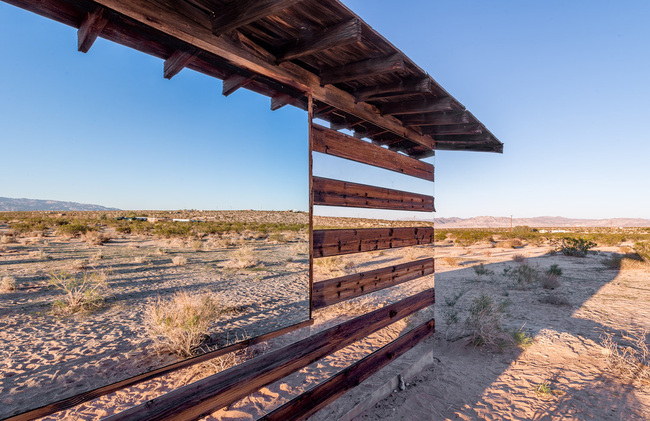
Deep in the Joshua Tree National Forest, in the deserts of California, artist Phillip K. Smith III revealed his beautiful architectural play of light, the so called “Lucid Stead” installation. An optical illusion, Phillip K. Smith III who received his Bachelor of Fine Arts and Bachelor of Architecture at the Rhode Island School of Design and often experiments with light and its reflections proves how simple it is to irritate our perception but also the transformational possibilities of light. Smith states, “Lucid Stead is about tapping into the quiet and the pace of change of the desert. When you slow down and align yourself with the desert, the project begins to unfold before you. It reveals that it is about light and shadow, reflected light, projected light, and change.”
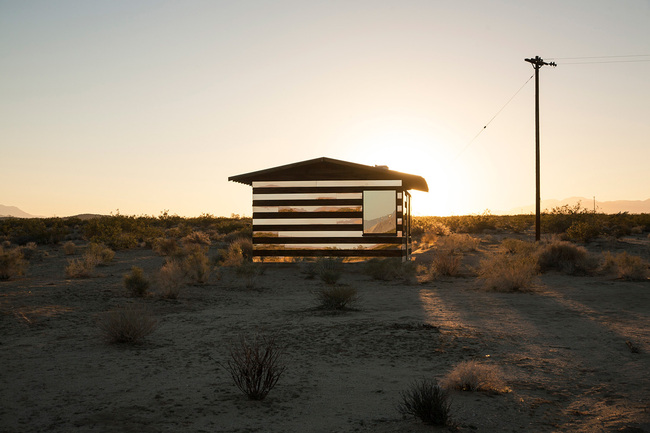
Composed of mirror, LED lighting, custom built electronic equipment and Arduino programming amalgamated with a preexisting structure, this architectural intervention seems alien in the context to the desert area and at the same time easily fit in it. As the sun moves the house’s appearance changes and turns it into an almost spiritual experience.
Phillip K. Smith draws inspiration from the reductive logic of minimalism and the optic sensation of California’s Light and Space movement. Learn more about his work and his solo exhibition of light works at royale projects which will open on November 29 2013 here.
All images via Archinect. Photo 1: Lucid Stead by Phillip K. Smith, III. Photo: Steve King. Photo 2: Lucid Stead by Phillip K. Smith, III. Photo: Lance Gerber.
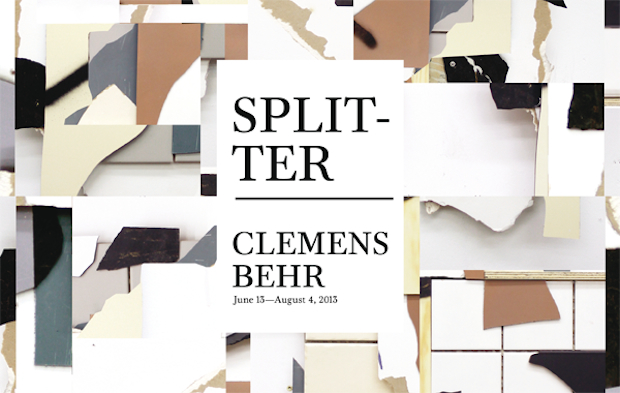
Young Berlin-based artist Clemens Behr‘s new installations “SPLITTER” are currently on display at Gestalten Space in Berlin. In “SPLITTER”, Behr remains true to his concept of site-specific works that are characterized by the use of found material and remind us of collages which have become three-d. Deconstructing and rearranging, Clemens Behr’s methods fluctuate between these extremes, but always manage to create new interesting compositions in the style of a contemporary Dadaism, which serve as reflections of his visual impressions of a given surrounding.
By playing with both destruction and construction, the artist raises questions about ephemerality and permanency, and in the same way, his work facilitates a dialogue between our perceptions in the second and third dimensions. Against this background, the importance of photography to Clemens Behr’s work becomes even clearer—thanks to photography, his spatial, walk-in installations can become striking cubistic images after the original structures have been destroyed. Alongside his temporary site-specific interventions, “SPLITTER” also presents a number of durable objects.
Within the framework of his exhibition at Gestalten Space, the German publishing house present a video interview. In this Gestalten.tv interview, Clemens Behr reflects on his visions in spatial design, his own visual vocabulary, and his free-spirited, performance-like design process.
Don’t miss ”SPLITTER” at Gestalten Space, Sophie-Gips-Höfe, Sophienstraße 21, 10178 Berlin, until 4 August 2013.
]]>
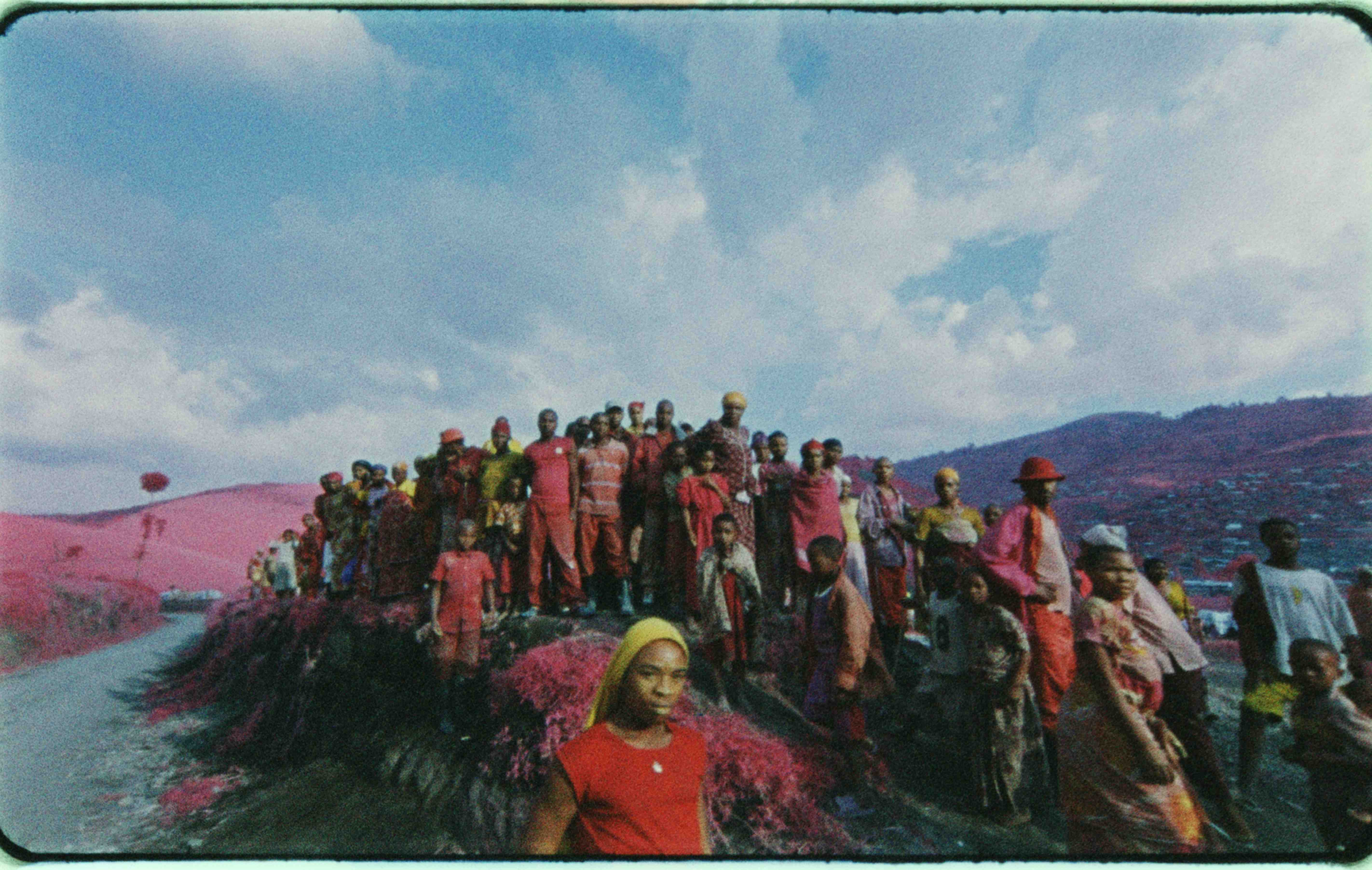
Grass is no longer green but pink. Trees, stones and the wide landscape, they all changed colours but what sounds like a fairytale wonderland, fails at second sight: armed soldiers in uniforms cross the landscape; people run through the streets; the atmosphere gets more and more disturbing. This is not surprising because the location and circumstances are anything but beautiful: Richard Mosse’s film „The Enclave“ ranges between documentary journalism and contemporary art as he captures life in Congo by using a discontinued military surveillance technology, a type of colour infrared film called Kodak Aerochrome. Originally developed for camouflage detection, this aerial reconnaissance film registers an invisible spectrum of infrared light, rendering the green landscape in vivid hues of lavender, crimson, and hot pink.
Richard Mosse’s „The Enclave“ is the Irish contribution to the current 55th International Art Exhibition – La Biennale di Venezia and will be opened until November 24th 2013. As a major new multi-media installation, which was commissioned and curated by Anna O’Sullivan, Director of the Butler Gallery in Kilkenny, the Irish artist collaborated with cinematographer Trevor Tweeten and composer Ben Frost to create a highly immersive five-screen multimedia installation that is a mythic conflation of many discrete enclaves in Eastern Congo. Inserted as journalists within armed groups, which fight nomadically in a war zone plagued by frequent ambushes, massacres and systematic sexual violence, the trio documented their environment by film, photography and sound. What could have been a two-fisted documentation turned into images that carry a fascinating and irritating atmosphere at the same time.

One reason for that is Mosse’s use of the Kodak Aerochrome film. Even though its origins can be found in military context and has found civilian uses among cartographers, agronomists, minerologists, and archaeologists to reveal subtle changes in the landscape, also Rock musicians like the Grateful Dead or Jimi Hendrix appropriated the medium in their artworks, making use of the psychedelic effect that follows the variation in colour. More than 50 years later, Richard Mosse utilises this paradox too: “Mosse uses this film to reveal a cancerous yet unseen humanitarian tragedy with a disturbing psychedelic palette, posing aesthetic questions in a situation of profound human suffering.”
The resulting imagery, shot on 16mm colour infrared film by Trevor Tweeten, renders the Sub-Saharan jungle war zone in sickly hues of crimson, purple, teal blue and hot pink. Entirely comprised of organic Congolese sound recordings, Ben Frost created an appending audio composition that adds to the visitor’s experience the sense of hearing. Altogether they push past the boundaries of adequate representation to create “a discomfiting and sinister world to penetrate sensibilities and make this ineffable nightmare visible.”
Richard Mosse: The Enclave, June 1st – November 24th 2013, La Biennale di Venezia, The Pavilion of Ireland.
Image 1: Still from ‘The Enclave’, shot on 16mm color infrared film in Eastern Congo, by Richard Mosse, 2012. A young soldier from Mai Mai Yakutumba poses in Savannah at a secret location near Lake Tanganyika, South Kivu, Eastern Congo, 2012. Images 2+3: Richard Mosse, The Enclave, 2013. Six screen film installation, color infrared film transferred to HD video. Filmed in Eastern Congo. Courtesy of the artist and Jack Shainman Gallery. Photo © Tom Powel Imaging inc.
A list of organizations the artist suggests for anyone looking to contribute to relief efforts in the Congo:
]]>